AI and the Professionals of the Future

- Published
- Updated
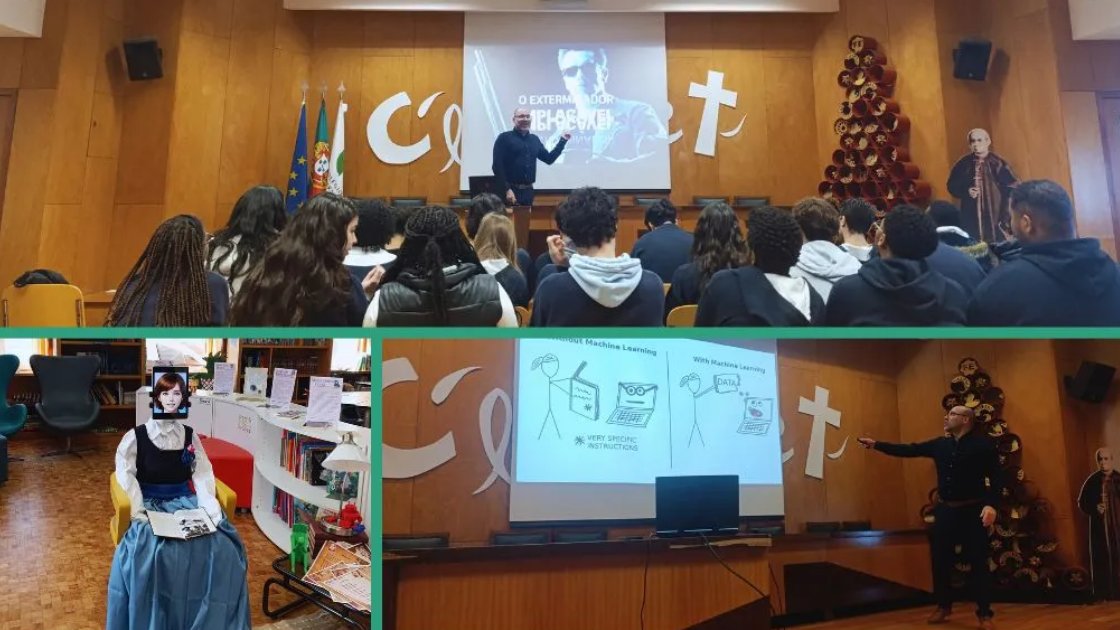
Yesterday I had the opportunity to speak with final-year students at Colégio Claret about Artificial Intelligence and the skills that can make a difference at the beginning of a career.
The main message was simple: AI is not only for specialists. It is a tool for learning, creating and solving problems. The advantage will not come from asking a machine to do everything, but from knowing how to frame good questions, evaluate answers and turn information into work of your own.
How can a student use AI without giving up learning?
AI can be a tutor, a practice partner or a production tool. Its value depends on how it is used.
A student can, for example:
- ask for the same concept to be explained at different levels of difficulty;
- create revision questions from their notes;
- compare arguments before writing an essay;
- simulate an interview for a placement;
- organise a realistic study plan;
- turn an idea into a first portfolio prototype.
The principle is to use the tool to think more and practise better, not to replace the effort that creates learning. If the AI provides an answer that the student cannot explain, that answer has not yet become knowledge.
Five skills for the professionals of the future
1. Defining problems
Before looking for a tool, understand what needs to be solved. A well-defined problem includes a goal, context, constraints and an expected result.
2. Asking better questions
Clear instructions produce more useful answers. This skill is not only for speaking to AI: it also improves communication with colleagues, clients and teams.
3. Verifying information
AI systems can make mistakes, omit context or present a claim with too much confidence. Checking sources, dates and calculations remains a human responsibility.
4. Creating and experimenting
Ideas gain value when they become something testable: a presentation, video, small website, prototype or experiment.
5. Keeping human judgement
Empathy, responsibility, intent and an understanding of context cannot be delegated. The more powerful the tool becomes, the more important it is to know when not to use it.
A practical exercise to get started
Choose a real task from school or a personal project and follow this process:
- Write the goal in your own words.
- Ask AI for three ways to approach the problem.
- Compare the options and choose one, explaining why.
- Produce a first version.
- Verify the facts and identify material drawn from external sources.
- Explain the result to someone else without using the tool.
This exercise develops AI literacy, critical thinking and communication at the same time.
A concrete example of moving from learning to creation is the process used to build an educational game with AI.
When the library found its voice
Among the books in the Colégio Claret library, we also saw an experience that brought tradition and technology together: a figure with the body of a mannequin and a screen for a face, giving a new presence to verses by Portuguese women poets.
The project made an important idea visible. Innovation does not have to erase what came before; it can create a new way into culture, history and creativity.
Tools are starting points, not skills
ChatGPT, Perplexity and Framer can be useful, but the names will change. The durable skill is knowing how to research, structure, create, test and learn with different tools.
Anyone who wants to explore concrete applications can use IAteca, SuperHumano Academy's AI app directory. The Academy's course catalogue helps turn discovery into practice, while SuperHumano AI works with educational teams through its AI in education programme.
Frequently asked questions
Will AI replace the students who are entering the workforce now?
It will transform tasks and roles, but it does not determine the future of a profession on its own. Professionals who understand their field, use AI with judgement and keep learning will be better prepared for that change.
Is using ChatGPT to study cheating?
It depends on the school's rules and how it is used. Asking for explanations or exercises can support learning; submitting AI-generated work as your own does not demonstrate knowledge and may breach assessment rules.
Where should a young person start?
With a small, verifiable task. Choosing a real problem, trying one tool, comparing the result with reliable sources and recording what was learned is more useful than testing dozens of applications without a goal.
Special thanks to Colégio Claret and Professor Nuno Sá for the invitation and for their commitment to preparing students to take part in this transformation with curiosity and responsibility.