AI Obesity: 7 Ways to Apply AI in an SME

- Published
- Updated
Artificial Intelligence is advancing quickly, but abundance also creates a problem: too many tools, demonstrations, newsletters and possibilities can leave leaders and teams overwhelmed and unsure where to start.
I call this state "AI obesity": accumulating applications and information without turning any of them into real capability. The answer is not to try everything. It is to choose one problem, test one application and measure the result.
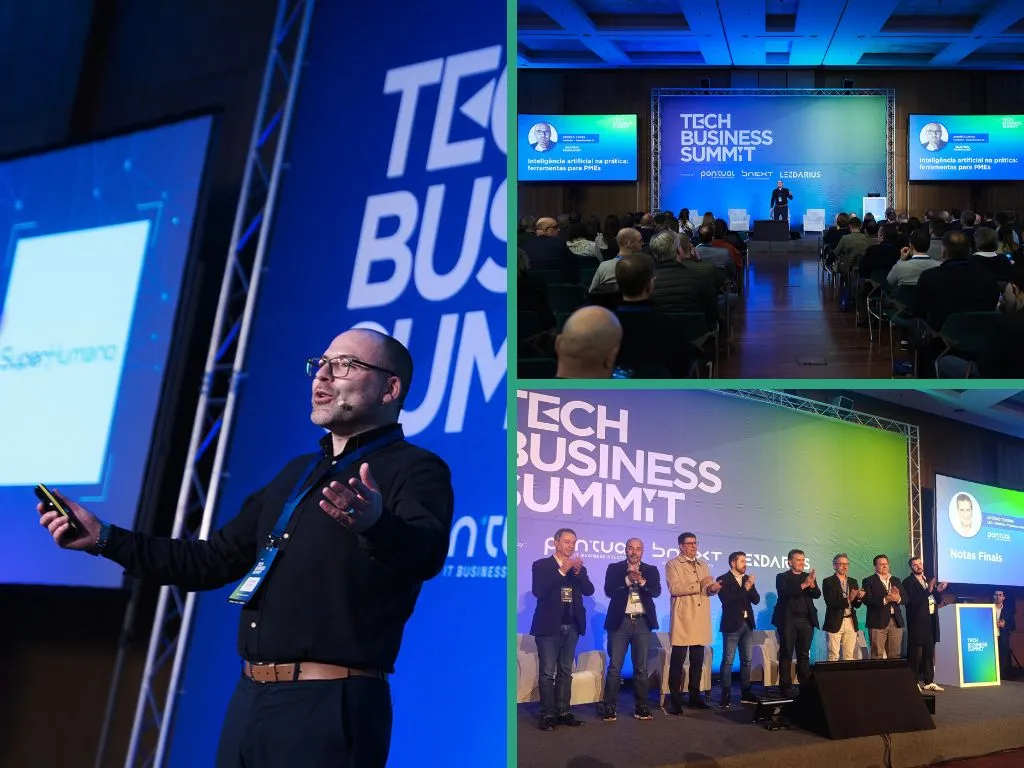
At Tech Business Summit, I presented seven ways to use AI in an SME. They are starting points, not a shopping list.
1. Create first drafts
Emails, proposals, descriptions and internal communications can begin with an assisted draft. Provide the audience, goal, facts, tone and length limit.
Measure: time between the request and an approved version.
Control: a person checks facts, language and commitments.
2. Summarise documents and meetings
AI can extract decisions, tasks, risks and questions from reports or notes. Ask it to distinguish explicit information from items that need confirmation.
Measure: preparation time and number of corrections.
Control: compare with the source before distributing.
3. Organise internal knowledge
Policies, manuals, proposals and frequently asked questions can feed a searchable knowledge base. Its value depends on current documents, permissions and source references.
Measure: time to find an answer and percentage of questions resolved.
Control: an owner and review date for each document.
4. Support customer service
An assistant can answer common questions, collect context and route requests. It should make automation clear and provide an easy path to a person.
Measure: first-response time, resolution and satisfaction.
Control: rules for complaints, urgent cases and sensitive information.
5. Prepare sales work
AI can summarise history, research an organisation, structure questions and create a first proposal draft.
Measure: preparation time, quality of records and opportunity progression.
Control: do not invent details about the prospect or send without review.
6. Explore data
A team can formulate questions about spreadsheets, identify patterns and create explanations. The model should work with an appropriate sample and calculations must be verified.
Measure: analysis time and decisions supported.
Control: validation of numbers, access and anonymisation.
7. Automate administrative tasks
Classifying forms, creating tasks, updating systems and sending notifications reduces repetitive work. Begin with a predictable and reversible flow.
Measure: executions, time saved, errors and interventions.
Control: logs, alerts, limits and a way to stop.
How do you choose between the seven use cases?
Use a simple matrix:
- Value: which outcome does it improve?
- Frequency: how often does it happen?
- Data: does the necessary information exist and may it be used?
- Risk: what is the impact of an error?
- Verification: can a person check it quickly?
- Adoption: can and will the team integrate the change?
Choose a case with clear value, low risk and straightforward review. Define a two-to-four-week test with a baseline.
Rules for avoiding AI obesity
- Do not buy a tool without an owner and use case.
- Maintain a list of authorised applications.
- End trials that never reach real work.
- Document approved prompts, data and criteria.
- Measure the complete process, including review.
- Share successful examples and failures.
- Review the tool portfolio every quarter.
These seven applications came from the presentation described in the article about AI for SMEs at Tech Business Summit.
Technology, people and process
An SME is not transformed by holding more licences. It needs to align technology with processes and build people's capability. Before moving ahead, use the SuperHumano Academy AI Maturity Index to identify priorities and IAteca to compare tools.
When the goal is to move from testing to implementation, explore SuperHumano AI's AI Solutions and Company of the Future area.
Frequently asked questions
What is "AI obesity"?
It is the accumulation of AI tools, information and experiments without consistent application, criteria or measurable results.
How many AI tools should an SME use?
There is no ideal number. Use the smallest set that covers approved cases, fits the work and meets requirements for data, cost and security.
What is the best first use case?
A frequent, time-consuming, low-risk task that is easy to verify. Drafting, summarisation and organising non-sensitive information are often good tests.
Who should lead adoption?
Leadership should set priorities and rules, but implementation needs the people who know the processes, those responsible for data and technology, and the end users.
Entrepreneurs already achieve a great deal with limited resources. AI can expand that capability when applied with focus, method and responsibility.